

Why do dentists put crowns on teeth?
There are a few reasons. One is that the tooth is fractured, and in order to keep it functioning in the bite with the opposing tooth, we may need to place a crown. Another reason is that when a tooth is fractured, the inner layer may become exposed, and a dental crown can help protect the tooth.
A third reason is aesthetics. If the teeth don't look aesthetic when the patient smiles, crowns may be used to improve their appearance. The fourth reason is that there may be decay on the tooth. After removing all the decay, there may be too little tooth structure remaining for a filling. If you want to keep the tooth, a crown may be recommended to protect the remaining tooth structure.
What are the differences between dental crowns and dental bridges?
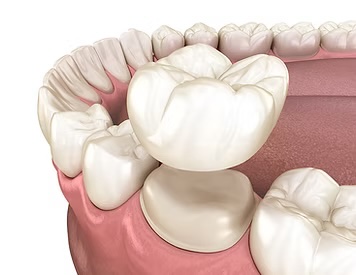
These are actually two totally different restorative scenarios, and I'm going to show them to you. A dental crown restores a single tooth. Single tooth, single crown.
A bridge is different. A bridge is used when you have two adjacent teeth next to an empty space where there is no tooth. We're using the two teeth to hold the bridge, and the bridge will provide three teeth. One of them replaces the missing tooth and is called the pontic. The two adjacent teeth are called the abutments. So, a bridge replaces a missing tooth, while a crown restores one single tooth.
What types of dental crowns are available?
In terms of materials, there are zirconia crowns, which are commonly used nowadays. There are also gold crowns made out of a gold alloy. Another option is a porcelain-fused-to-metal crown, which is a porcelain ceramic material fused to an underlying metal alloy. There are other materials on the market, but these are three of the major categories.
What type of crown is best for the front teeth?
Nowadays, zirconia can be a material of choice for many anterior tooth crowns. There are also other materials, such as feldspathic porcelain, which is used for veneers, or lithium disilicate, which can be used for crowns or veneers. The choice depends on how much translucency you want to see in the restoration versus how much strength you want to gain.
Generally, as the strength of a ceramic restoration increases, the translucency decreases. Feldspathic porcelain is very translucent and aesthetic, but it isn't used as a crown by itself because it doesn't have the necessary strength. Lithium disilicate, also known as e.max, can be used for either veneers or crowns. It's less translucent than feldspathic porcelain, but it's stronger and can be used for anterior crowns.
Very strong zirconia isn't as translucent, so it may not be as aesthetic for anterior teeth. Nowadays, zirconia can be made in different strengths, and there are zirconia materials with multiple layers. These are called multilayer zirconia. The layer by the gums is stronger, and as we move toward the edge of the tooth away from the gum, the material becomes more translucent. This combines strength at the base of the tooth with greater translucency and aesthetics toward the edge.
Is it possible to not get a crown after a root canal?
It may be possible not to get a crown after a root canal if the tooth is intact. However, a crown is often recommended because a tooth that has had root canal treatment may be weakened. A crown can help keep the tooth intact and provide protection. Whether a crown is needed depends on the tooth and its condition.
How do different dental crown materials compare?
I touched on this briefly before, but I'm going to add a little bit more. Nowadays, a commonly used material for dental crowns is zirconia, and it can come as single-layer or multilayer zirconia. Single-layer zirconia has the same strength, color, and translucency throughout. The stronger it is, the less translucent it tends to be.
For the posterior teeth, translucency may not matter as much because you don't really see those teeth. For the front teeth, you may want more translucency. The benefit of some zirconia materials now is that they can be multilayered. They can be very strong at the base, and as they move toward the edge of the tooth away from the gum, they become more translucent. For the back teeth, we generally want strong zirconia to withstand the forces in that area.
Besides zirconia, another material is lithium disilicate, also known as e.max. It's more translucent but less strong than zirconia, so we consider where it's being used, particularly for posterior teeth where biting forces can be greater.
Other crown materials include full-cast metal, which is usually a gold alloy. Some people want to have a gold tooth in the front or back, and gold can be used in those situations. It has a long history of use in dentistry.
The fourth category is porcelain fused to metal. Porcelain fused to metal is a ceramic material, porcelain, that's fused to a metal alloy substructure. On the outside, you see the porcelain, which is the white, translucent material. On the inside is the metal, which provides strength. It's been used successfully for many years, although it's being used less nowadays because other materials can also provide strength and aesthetics and may be more practical to use.
Are crowns as strong as real teeth?
Yes and no. Natural teeth are very strong, and if a tooth is fracturing, it's fracturing for a reason. We need to find out why it fractured. Crowns can provide strength and protection for a fractured tooth. However, crowns can also fracture.
When deciding whether to crown a fractured tooth, the goal is to protect the remaining tooth and help it last longer. Some crown materials, particularly zirconia, are very strong and can hold up well over time.
What are the steps of the dental crown procedure?
First of all, you make an appointment for an initial exam. Your medical history and dental history will be reviewed, and you'll have a dental exam. If a crown is indicated for you, then you'll be scheduled for the crown appointment.
It will usually involve two appointments. At the first appointment, we'll prepare the tooth for the crown. If a buildup is needed, that will be done. If there is any decay, the decay will be removed, and the tooth will be prepared for the crown. At that appointment, molds will be taken to make the necessary measurements, and they'll be sent to the lab to fabricate your final crown.
In the meantime, you'll go home with a temporary crown. A temporary crown is similar to the final crown, but it's made from an in-office material that's weaker than the final material. It's also cemented with temporary cement so that when your final crown comes in for your second visit, we're able to remove the temporary crown. The lab will fabricate your final crown, and when you come in for your second visit, the final crown will be placed.
What type of anesthesia is used for dental crowns?
It will mostly be regular local anesthesia, which numbs the tooth and helps keep you comfortable throughout the procedure.
Are there special instructions for brushing and flossing after getting a dental crown?
Yes, there are special instructions, and you can find them on our website. In general, you do need to floss where you got the crown. With a temporary crown, you put the floss in and take it out from the side rather than pulling it back up, which could dislodge the temporary crown. In terms of brushing, definitely brush all your teeth. I recommend brushing along the gums as well to help keep the area clean.
How long do dental crowns last?
It's hard to say. Ideally, the goal is 10 years or more. Sometimes a dental crown won't last 10 years, while some patients have crowns that last 15 or 20 years or longer. Our goal is really to place a crown and have it last as long as possible.
Some complications involving dental crowns aren't necessarily related to the crown itself, but rather the underlying tooth. There may be new decay, trauma, or gum disease that requires additional treatment to the tooth. I see patients who have had their crowns for many years, so crowns can have a long lifespan, although it varies from patient to patient.
How can you tell if you have tooth decay under a crown?
There are two ways of finding out. One is with X-rays, which provide images of the area. Another important way is a clinical exam using a dental instrument. We can examine around the tooth where the tooth and crown meet to see if there's any decay. This is usually done during your initial dental exam and periodic follow-up exams.
What is the typical cost of a dental crown?
It really varies from office to office. I recommend finding out when you visit your dentist and discussing the typical cost of a dental crown for your situation.
How can you schedule an appointment for a dental crown?
You'll need to have an exam to find out whether you need a crown and whether you're a good candidate for one.
If you're ready to schedule an exam or would like to learn more about our services, we'd love to hear from you. Call us at (585) 522-1922 or email rocprostho@gmail.com. We look forward to caring for your smile.