Superior Function and Comfort Over Removable Dentures
Dr. Kuyunov, a leading prosthodontist in Rochester, NY, is a dental implant dentist dedicated to ensuring that his patients who are interested in receiving full-arch implants are made as comfortable as possible throughout the entire process.
What are full-arch dental implants?
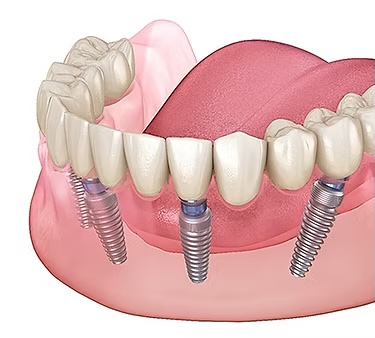
Full-arch dental implants are used when there is a need to replace a full dental arch (the top or bottom teeth) for patients who are missing most or all of their natural teeth. Full-arch fixed prostheses on dental implants look and function like natural teeth. For full-arch dental implants, four or more medical-grade titanium implants are inserted into your jawbone. A full set of teeth is then permanently affixed to the implants.
What are full-mouth dental implants?
If you are missing most or all of your upper and lower teeth, you can receive both the top and bottom full-arch implants, also known as full-mouth dental implants. The prosthetic teeth are then affixed to the implants. After receiving your full-mouth fixed prostheses, you will gain a more natural biting and chewing capacity.
What are implant-supported dentures, and how are they different from traditional dentures?
Traditional dentures rely on your gums and the underlying bone for support and stability. While they work well for some people, others find that they move during eating or speaking, making them less comfortable and more difficult to wear.
Implant-supported dentures were developed to provide a more secure solution. Instead of resting only on the gums, the denture is attached to dental implants that are placed in the jawbone.
For example, two dental implants are commonly placed in the lower jaw to support a removable denture. The denture contains special attachments that securely snap onto the implants, creating a stable fit while still allowing the denture to be removed for cleaning.
This snap-in design provides significantly more stability than a traditional lower denture and can make eating, speaking, and smiling much more comfortable.
Research has shown that implant-supported dentures offer important advantages for many patients. In fact, an international group of dental experts concluded that a two-implant overdenture should be considered the minimum standard of care for many patients who are completely missing their lower teeth.
While traditional upper dentures often provide good retention because of natural suction, lower dentures typically benefit much more from implant support.
How do implant-supported dentures work, and what does the treatment process involve?
Creating implant-supported dentures involves both denture fabrication and dental implant treatment.
The first step is determining whether you're a good candidate for dental implants.
Comprehensive Evaluation
Your dentist will begin by reviewing your medical history and obtaining a three-dimensional CBCT scan. This advanced imaging allows us to evaluate your bone volume, identify important anatomical structures, and determine whether implants can be placed safely.
We'll also evaluate your overall health to identify any medical conditions that could affect healing or implant success.
Treatment Planning
Careful planning is one of the most important parts of implant treatment.
If you already wear dentures, they may be used as a guide during surgery. If you don't currently have dentures, a temporary denture may first be fabricated to help plan ideal implant placement.
During this stage, we also evaluate whether there is enough space to accommodate both the implants and the new denture. In some situations, years of missing teeth can result in changes to the bite that require additional planning before treatment can begin.
Implant Placement and Healing
Once planning is complete, the dental implants are surgically placed into the jawbone.
After surgery, the implants are generally allowed to heal undisturbed for approximately three months. During this healing period, the surrounding bone gradually bonds to the implants through a process called osseointegration, creating a strong and stable foundation.
During this time, you'll typically continue wearing your existing denture or another temporary replacement.
Allowing adequate healing time is important because placing too much pressure on newly placed implants before they have fully integrated may increase the risk of implant failure.
Final Denture Placement
Once healing is complete, the denture is connected to the implants using special attachments.
If you're happy with your current denture, it can often be modified to snap securely onto two, three, or even four implants.
If your current denture no longer fits well or you're looking for a completely new smile, a brand-new denture can be fabricated specifically to work with your implants.
At your final appointment, your implant-supported denture will be attached, and you'll receive detailed instructions on how to care for both your dentures and your dental implants to help ensure long-term success.
What is the difference between snap-in dentures and permanent implant-supported dentures?
A snap-in denture is exactly what the name suggests. It securely snaps onto dental implants, but you can remove it each day for cleaning before snapping it back into place. It functions much like a traditional denture, except it has the added stability of being attached to implants.
A permanent implant-supported denture is actually more like a full-arch bridge than a traditional denture. Typically, four or more implants are placed into the jawbone, and the bridge is securely attached to those implants with screws.
Unlike a snap-in denture, you cannot remove a permanent implant-supported bridge yourself. It stays fixed in place, allowing you to eat, smile, and speak with confidence. Your dentist can remove it during maintenance visits to inspect the implants, thoroughly clean the restoration, and then securely place it back.
One of the biggest advantages of a fixed implant-supported bridge is that it feels much more like natural teeth. Most people won't even realize you're wearing a prosthesis because it is securely attached and designed to look and function like your natural smile.
What are the benefits of full-arch and full-mouth dental implants?
As explained on our dental implants page, there are many overall benefits of getting dental implants. Some of these include restoring your beautiful smile, regaining your self-confidence, and improving biting and chewing function. Full-arch or full-mouth dental implants have several benefits over conventional dentures, which include:
- Improved Taste Sensation: Conventional upper dentures cover the palate, thus covering the upper taste buds. Full-arch dental implants keep the palate open.
- Functionality and Comfort: Conventional dentures can irritate the gums and can be uncomfortable while chewing or talking vs. full-mouth dental implants function more like natural teeth.
- Increased Stability: Full-mouth dental implants are permanent and are as stable as natural teeth vs. conventional dentures that can move and slip while chewing or talking.
- Preservation of Bone Structure: Full-mouth dental implants help retain bone integrity vs. dentures that will not protect against jawbone loss since the bone that previously surrounded the tooth roots can begin to deteriorate from wearing dentures.
- Improved Nutrition: Conventional dentures can make it difficult to eat certain foods which can lead to a decrease in health and quality of life vs. full-mouth dental implants that allow you to eat almost any foods you desire.
What are the benefits of implant-supported dentures compared to traditional dentures?
Traditional removable dentures rest directly on the gums and rely on suction, your cheeks, and your tongue to help keep them in place. While this works well for some patients, others experience movement, slipping, or difficulty chewing.
Implant-supported dentures provide greater stability because they are anchored directly to dental implants. The implants work together with the denture to create a much more secure fit.
With a fixed implant-supported bridge, the restoration is attached entirely to the implants and does not rely on suction or the gums for support. This creates an even stronger and more stable solution.
One of the greatest benefits is confidence. Patients often report feeling much more comfortable eating, speaking, and smiling because they no longer worry about their dentures moving or slipping.
Research has consistently shown that implant-supported dentures improve patient satisfaction, quality of life, chewing ability, and overall comfort compared to traditional removable dentures.
If you are looking to replace missing teeth and are considering full-arch or full-mouth dental implants in Rochester, NY, Dr. Isaac Kuyunov will perform a complete and careful examination of your jaw, teeth, mouth, and overall health to determine if dental implants are the best option for you.
What should I expect when getting full-mouth denture implants?
The most important thing to understand is that this treatment is a process. From beginning to end, there is a transition period that typically lasts between three and six months.
Like any surgical procedure, placing dental implants requires healing time. After your diagnostic evaluation and implant surgery, your jawbone needs time to integrate with the implants before the final restoration can be placed.
During the healing phase, you'll wear a temporary appliance. Depending on your treatment plan, this may be either a removable denture or a temporary fixed restoration. Because it is temporary, you'll need to follow your dentist's instructions carefully, including eating a softer diet and avoiding excessive pressure while chewing.
Once healing is complete, your final implant-supported restoration is placed. At that point, you'll be able to return to normal eating, speaking, and daily activities with a stable, strong, and secure smile that is designed to function for many years.
Who makes a good candidate for full-arch dental implants?
If you are looking for full-arch or full-mouth dental implants in Rochester, NY, our practice is the ideal choice. Our team will do all we can to make this process as comfortable for you as possible. Here are several scenarios where a person might need full-arch or full-mouth dental implants:
- You suffer from gum disease and have loose and missing teeth.
- You have lost most or all of your teeth due to severe tooth decay or have worn down your teeth due to chronic teeth grinding/bruxism.
- You currently wear dentures and are experiencing discomfort.
- You are looking to improve the function and appearance of your smile.
Who is a good candidate for implant-supported dentures?
A good candidate is someone who is healthy enough for dental implant treatment and does not have significant medical or lifestyle factors that could interfere with healing.
One of the most common risk factors is smoking. Smoking has been shown to decrease implant success because it creates an environment that makes healing more difficult and increases the risk of implant failure.
Another important consideration is diabetes. Well-controlled Type 2 diabetes is generally not a contraindication to dental implants. However, poorly controlled diabetes can significantly reduce healing and increase the risk of implant failure. Your physician can evaluate your blood sugar control using a hemoglobin A1C test before treatment.
Certain medications may also affect whether implants are recommended. For example, some medications used to treat osteoporosis or improve bone density can interfere with normal bone healing. If you take these medications, your dentist will discuss how they may affect implant treatment and whether any precautions are necessary.
Good oral hygiene is another essential factor. Dental implants require the same daily brushing, flossing, and professional maintenance appointments as natural teeth. Patients who are committed to caring for their implants typically experience the best long-term success.
Patients who grind or clench their teeth may also require modifications to their treatment plan, such as additional implants or a stronger prosthesis, because grinding places greater forces on both the implants and the restoration.
Overall, the best candidates are patients who are in good general health, practice excellent oral hygiene, avoid smoking, have well-controlled medical conditions, and do not take medications that significantly interfere with bone healing.
Are there any differences between upper and lower denture implants?
The prosthesis itself is very similar for both the upper and lower jaw, although the number of implants used may vary depending on your individual treatment plan.
The biggest difference is how traditional dentures function. Lower dentures tend to move much more because the anatomy of the lower jaw provides less natural retention than the upper jaw. This is why implant-supported dentures are strongly recommended for the lower jaw. In fact, the McGill Consensus recommends a two-implant overdenture as the minimum standard of care for patients with a completely toothless lower jaw.
For the upper jaw, traditional dentures often achieve better natural suction and retention. However, they typically cover the roof of the mouth (the palate), which can affect taste, speech, and overall comfort.
With a fixed implant-supported restoration, the palate remains uncovered. Many patients prefer this because it feels much more like having natural teeth. Without the palate being covered, eating, speaking, and tasting food often feel more natural.
How much do denture implants cost, and what affects the price?
There is a range of pricing for implant-supported dentures, but the difference between providers often comes down to much more than the cost itself.
When choosing a provider, it's important to consider the quality of care, the experience of the dental team, the level of support you'll receive throughout treatment, and the trust you have in your provider. Many patients ultimately choose an office based on how comfortable they feel rather than simply selecting the lowest or highest price.
At our office, we focus on supporting patients throughout the entire process. Whether the implant surgery is completed here or by another specialist, we work closely with you from the initial consultation through the final restoration. Our goal is to make sure you feel informed, comfortable, and supported every step of the way.
Are there affordable options for implant-supported dentures?
Yes. There are several implant-supported denture options available, allowing treatment to be customized to both your clinical needs and your budget.
Generally, a fixed implant-supported bridge is the more expensive option because it is permanently attached to the implants. A removable snap-in denture is typically more affordable while still providing significantly greater stability than a traditional denture.
Many patients also ask whether they can begin with a snap-in denture and later upgrade to a fixed restoration. In many cases, the answer is yes. If the treatment is properly planned from the beginning, additional implants can often be placed later to convert a snap-in denture into a fixed implant-supported bridge.
This approach is more commonly performed in the lower jaw than the upper jaw, but careful planning from the beginning is essential to ensure the implants are positioned appropriately for future treatment.
What should I look for when choosing a provider for denture implants?
When researching denture implant providers, look for an office where you feel comfortable and confident in the care you'll receive. Consider the experience of the dental team, the level of communication, and the support provided before, during, and after treatment.
It's also helpful to speak with patients who have had similar treatment and learn about their experiences. Reading reviews and asking questions during your consultation can help you make an informed decision.
You can also discuss your options with your general dentist to see what they recommend. While cost is certainly an important consideration, it shouldn't be the only deciding factor. The skill of your provider, the quality of treatment, and the ongoing support you receive throughout the process are often the most important factors in achieving a successful long-term outcome.
Dr. Isaac Kuyunov, Prosthodontist and Dental Implant Dentist in Rochester, NY
Ready to learn more? Dental Prosthodontics of Rochester full-mouth and full-arch dental implant specialists can help you regain the confidence and function of a full smile. To schedule a personalized one-on-one consultation with Dr. Isaac Kuyunov, call us today at (585) 522-1922 or click the link below.